

DTF Hot-Melt Powder: Types, Grain Size and Curing
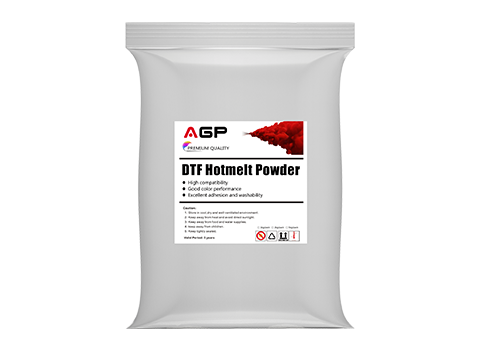
The powder is the part of DTF that decides whether a print survives the first wash, and it is the part most operators understand least. Ink and film are visible on the print; powder is a white dust you shake on and heat. But the adhesive bond between your transfer and the shirt is entirely the powder's job — and three parameters decide it: the polymer type, the grain size, and how completely it melts.
Get those right and a 50-wash print is routine. Get them wrong and you get prints that crack, feel like plastic, or peel off in the machine.
Quick Action Plan: Three Settings That Decide Everything
- Polymer type — standard TPU for cotton and blends; low-melt or anti-bleed for polyester and dark dyes.
- Grain size — fine for detail and soft hand-feel, coarser for heavy coverage and lower cost.
- Cure completeness — powder must melt to a clear, glossy film. Any visible white grain means under-cured.
What the Powder Actually Does
A DTF transfer is a stack: film, release layer, white ink, colour ink, powder. Under heat the powder melts, flows into the ink layer, and becomes a thermoplastic adhesive. When you press the transfer onto fabric, that same adhesive softens again and bonds to the fibres.
Two consequences follow, and they explain almost every powder problem:
- The powder must melt fully on the film, then re-melt on the garment. If it does not fully melt the first time, it cannot bond the second time — you get a print that looks fine and fails in the wash.
- The adhesive layer is also the hand-feel. More powder means a stronger bond and a stiffer print. There is a direct trade between durability and softness, and grain size is how you move along it.
The Four Powder Types
| Type | Melts at | Best for | What it solves |
|---|---|---|---|
| Standard TPU | Higher | Cotton, cotton blends, light colours | The default; strong bond, moderate softness |
| Low-melt TPU | Lower | Polyester, heat-sensitive fabrics, delicate synthetics | Bonds below the temperature at which polyester dyes migrate |
| Anti-bleed (black) powder | Lower | Dark polyester, sublimated fabrics | Blocks dye migration that would turn white ink yellow or pink |
| Fine / soft-hand powder | Similar | Detail work, fine text, garments where feel matters | Thinner adhesive layer, softer finish |
The choice that matters most is standard versus low-melt. Standard TPU gives the strongest bond at normal pressing temperatures. On polyester, though, those temperatures are exactly where disperse dyes turn to gas and migrate upward into your white ink — which is why dark polyester prints turn yellow, pink or grey after a day or two. Low-melt and anti-bleed powders exist to bond below that threshold.
If you print a lot of polyester, this single choice removes a whole category of complaint. See our white ink yellowing guide for the full mechanism.
Grain Size: What the Micron Number Changes
Powder is graded by particle size, commonly quoted in microns. The range used in DTF is roughly 80 to 170 microns, and the number changes four things at once:
| Property | Fine powder | Coarse powder |
|---|---|---|
| Detail retention | High — fine lines stay sharp | Lower — fine text can fill in |
| Hand-feel | Softer, thinner film | Stiffer, more noticeable |
| Coverage per gram | Lower — more surface area per weight | Higher |
| Dusting behaviour | More airborne dust, harder to control | Settles faster, easier to reclaim |
Fine is not automatically better. For a large solid white area on a hoodie, coarse powder gives a more even layer and less waste. For 8pt text and hairline detail, fine powder preserves the edge. Many shops keep two grades and match them to the job rather than standardising on one.
One practical note: finer powder produces more airborne dust, which is a ventilation and cleanup issue as much as a quality one. See our ventilation guide if you have not addressed extraction.
Curing: How to Tell It Is Done
The single most useful visual test in DTF: fully cured powder becomes clear and glossy. Not white, not milky, not matte — clear.
| What you see | What it means | What to change |
|---|---|---|
| White, powdery surface | Not melted at all | Temperature too low, or time too short |
| Milky / hazy | Partially melted | Raise temperature slightly or extend dwell |
| Clear with visible grain texture | Melted, but grain too coarse for the job | Switch to finer powder |
| Clear, glossy, slightly textured ("orange peel") | Correct | Nothing — this is the target |
| Brown or yellow tinge | Scorched | Temperature too high or time too long |
Cure temperature and press temperature are different things, and conflating them is common. Curing melts the powder into the ink on the film. Pressing re-melts it to bond to fabric. A transfer that was cured correctly can still fail if the press is too cool, and a perfectly pressed transfer cannot rescue powder that was never fully melted.
Common Powder Faults and Their Causes
| Symptom | Most likely cause | Fix |
|---|---|---|
| Print cracks after a few washes | Under-cured powder, or too little powder | Verify full melt; increase deposition slightly |
| Print feels stiff or plastic | Too much powder, or coarse grade | Reduce deposition; try finer grade |
| White areas turn yellow on polyester | Dye migration — standard powder at high press temp | Switch to anti-bleed / low-melt powder, reduce press temp |
| Powder falls off before curing | Excess powder not shaken off | Improve shaking or use a shaker with a reclaim cycle |
| Patchy, uneven surface | Uneven deposition — usually manual application | Shaker, or improve manual technique with consistent motion |
| Fine detail filled in | Powder too coarse | Finer grade |
Manual Powdering vs a Shaker
Manual powdering works, and at low volume it is the sensible starting point. What it cannot do is give you consistency: the same operator will deposit different amounts on the first and last transfer of a shift, and two operators will differ more.
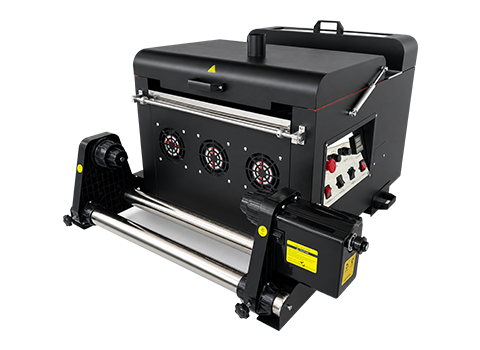
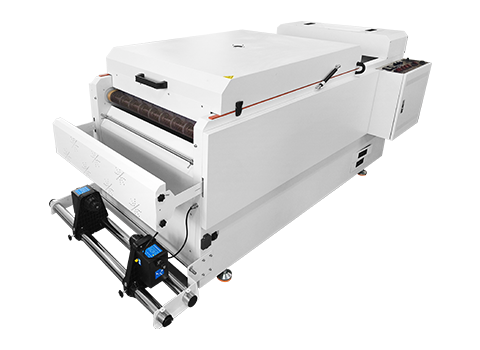
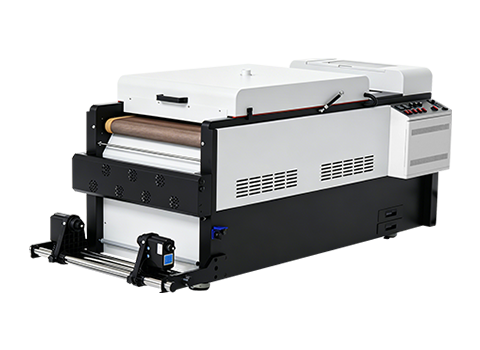
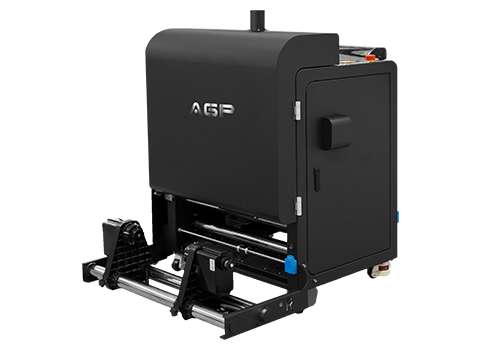
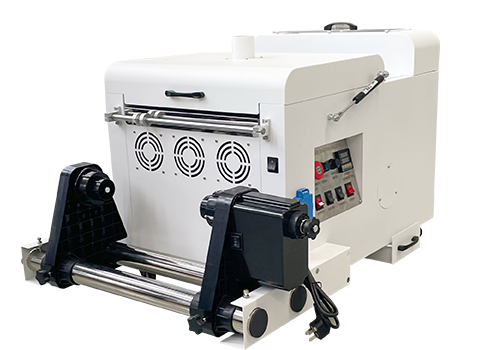
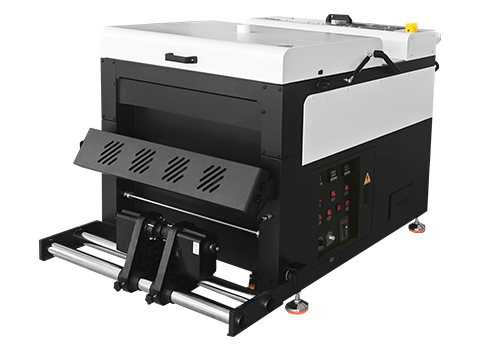
A shaker does three things manual application cannot — even deposition, consistent reclaim of excess powder, and a repeatable cure pass if it is an integrated unit. The crossover is roughly where uneven powder becomes your quality complaint rate rather than your throughput limit. Below that, manual is fine; above it, the variance shows up as customer returns before it shows up as a bottleneck.
Frequently Asked Questions (FAQ)
What is DTF powder made of?
Thermoplastic polyurethane (TPU) — a polymer that melts with heat, solidifies on cooling, and re-melts when pressed again. That reversibility is what makes DTF work: the same material bonds the ink to the film and then the film to the garment.
What is the difference between DTF powder and adhesive powder for other processes?
DTF powder is formulated to melt into a textile pigment ink layer and to remain flexible on fabric after washing. Powders used for other processes have different melt points, particle sizes and flexibility, and are not interchangeable — using the wrong one produces either a print that will not bond or one that cracks.
Why does my DTF print feel stiff?
Three causes: too much powder deposited, a coarse grain size, or a heavy ink layer underneath. Reduce deposition first — it is free — then move to a finer grade. On very fine knits, some stiffness is unavoidable because the adhesive layer is a film by definition.
Do I need different powder for polyester?
You need low-melt or anti-bleed powder, yes. Standard powder requires press temperatures at which polyester's disperse dyes gas out and migrate into the white ink layer, which is the mechanism behind yellow, pink and grey discolouration on dark polyester. Low-melt powder bonds below that threshold.
How do I know if my powder is fully cured?
It turns clear and glossy. White or milky means under-cured; brown or yellow means scorched. Hold the transfer at an angle to a light — the reflection should be even and glassy, with a slight "orange peel" texture. That is the target appearance.
Can I reuse excess powder?
Yes, if it has not been contaminated with dust, lint or cured particles. Sift it before returning it to the container. Powder that has picked up cured granules will produce a gritty print surface, so a shaker with a reclaim screen is worth having at volume.
Match the Powder to Your Fabric Mix
Tell us what you print on — cotton, polyester, blends, dark garments — and we will recommend the powder grade and cure settings for that mix, and quote a shaker sized to your daily volume.
Ask for a Powder and Shaker Recommendation