

Spot UV vs UV Flatbed Printing: Two Different Things With One Name
Spot UV is a finishing process applied to already-printed paper — a glossy varnish cured in selected areas, usually on business cards, packaging and book covers. UV flatbed printing is a machine that prints full-colour images directly onto objects. They share the word "UV" and the curing mechanism, and nothing else.
If you searched for "spot UV printing" and landed on a page about UV flatbed printers, that is why. This article separates the two clearly, tells you which one your project actually needs, and explains the small-batch middle ground where a UV flatbed can approximate a spot UV effect.
Quick Action Plan: Which One You Need
- You have printed paper, cards or packaging and want a raised, glossy patch on it: You need spot UV finishing — an offline screen or flexo unit, not a printer. AGP does not make this equipment.
- You want to print full-colour images onto a physical object — a board, a phone case, a metal panel: You need a UV flatbed printer.
- You want a short run of 20–200 pieces with a glossy raised effect and no print budget for a finishing line: A UV flatbed with a clear varnish channel is the practical workaround, with limitations explained below.
The Two Processes Side by Side
| Spot UV | UV flatbed printing | |
|---|---|---|
| What it is | A finishing coat — clear UV varnish applied to selected areas of a printed sheet | A digital printing method — UV-curable ink jetted onto a substrate |
| Input | Already-printed paper or board | A blank object |
| Output | A printed sheet with glossy raised patches | A printed object |
| Equipment | Screen printer, flexo unit or dedicated spot UV coater, plus a UV curing tunnel | UV flatbed printer |
| Typical equipment | A finishing line: screen or flexo unit plus a UV curing tunnel | A digital printer with a vacuum table |
| Setup per pattern | A screen or plate must be produced | None — digital |
| Minimum run | Hundreds to thousands — setup dominates | One piece |
| Where it wins | High-volume packaging, luxury cards, book covers | Short runs, objects, personalisation, prototypes |
| Who does it | Trade finishers, packaging printers | Sign shops, product decorators, manufacturers |
The confusion is understandable: both use UV light to cure a liquid into a hard, glossy film. But one is a finishing step in a print workflow, and the other is the print itself.
What Spot UV Actually Is
A commercial printer prints the job on an offset or digital press. Then, in a separate pass, a clear UV varnish is applied only to chosen areas — a logo, a pattern, a border — and cured instantly under UV lamps. The result is a raised, glossy element against a matte background.
It exists because offset printing cannot produce variable gloss. Everything on an offset sheet has the same finish. Spot UV breaks that constraint by adding a second, targeted layer.
Three things follow from that, and they explain why it is not a printer's job:
- You need the printed sheet first. There is nothing to spot-UV until something is printed.
- Setup cost dominates. A screen or plate must be made for the pattern, so short runs are uneconomical — the classic minimum is several hundred to a few thousand pieces.
- The equipment is a finishing line, not an imaging device. It applies varnish through a patterned screen or plate; it does not print colour.
What a UV Flatbed Does, and Where the Overlap Is
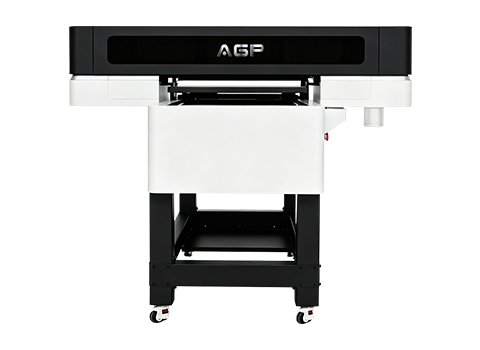
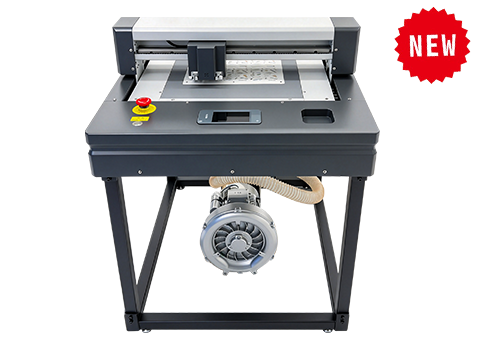
A UV flatbed prints CMYK plus white plus, on many machines, a clear varnish channel. It prints onto a board or object placed on its vacuum table, and cures the ink instantly with a UV lamp mounted on the carriage.
That clear channel is the source of the overlap: you can print colour, then print clear varnish on top of a selected area, producing a raised glossy patch on a single object. For a run of 20 phone cases or 100 branded coasters, this is a genuine alternative to ordering spot UV finishing.
But it is not the same product, and the differences matter commercially:
| Spot UV on paper | UV flatbed clear varnish | |
|---|---|---|
| Substrate | Paper and board | Rigid objects and panels |
| Registration accuracy | Very high — plates align to print | Good, limited by machine resolution |
| Raised height | High, controllable via screen mesh | Lower, limited by ink deposit per pass |
| Cost at 5,000 pieces | Low per unit | High — it is a digital process |
| Cost at 50 pieces | High per unit — setup dominates | Low — no setup |
The rule: Spot UV wins above roughly 1,000 identical pieces on paper. A UV flatbed wins below a few hundred pieces, or when the substrate is not paper.
The Adjacent Thing People Also Mean: UV Varnish as a Top Coat
A third term gets mixed in — full-surface UV coating, where the entire printed sheet is coated for protection and gloss. That is a flood coat, not a spot coat, and it is done inline on the press or in a coater.
On a UV flatbed, the equivalent is printing clear varnish over the whole image to protect it from abrasion. It is worth doing on any object that will be handled: varnish roughly doubles abrasion resistance and slows UV fading.
Frequently Asked Questions (FAQ)
Is spot UV the same as UV printing?
No. Spot UV is a finishing process that applies clear varnish to selected areas of already-printed paper. UV printing is a digital printing method that jets UV-curable ink onto a substrate. They share the curing mechanism, not the function.
Can a UV flatbed printer do spot UV?
It can produce a similar visual effect — a raised glossy patch — by printing clear varnish over a selected area. It is a practical alternative for short runs and non-paper substrates, but the raised height is lower and the per-unit cost is much higher than screen-applied spot UV at volume.
What equipment do I need for spot UV on business cards?
A screen printer with a UV curing tunnel, or a dedicated spot UV coater, plus the screen or plate for the pattern. For small quantities, most print shops outsource to a trade finisher rather than owning the equipment.
Why is spot UV so expensive for small quantities?
Because a screen or plate must be produced for each pattern, and the machine setup time is fixed regardless of run length. At 200 pieces the setup cost dominates the unit price; at 5,000 pieces it disappears.
Which gives a better raised effect — spot UV or UV varnish on a flatbed?
Spot UV, generally. Screen application deposits a much thicker varnish layer than an inkjet head can in one pass, so the tactile raised effect is more pronounced. If the raised feel is the whole point of the design, screen-applied spot UV is the correct process.
If You Need to Print on Objects Rather Than Paper
Tell us the object, the material and the run length. If a UV flatbed is the right process we will quote one; if your job is actually paper finishing, we will say so and point you to a trade finisher.
Describe Your Object and Get a Process Recommendation