

DTF Printer Total Cost of Ownership: The Five Lines That Decide
Most DTF purchase decisions compare one number and ignore four.** The purchase price is the smallest line in the calculation, and the only one every supplier quotes in the same unit. The four lines that actually decide whether the machine makes money — consumables, labour, spares and downtime — are all invisible on a quotation and all larger by year two.
This page gives the calculation, the five lines, and the specific data to request from every supplier so the comparison is like for like.
Quick Action Plan: Get These Five Numbers Before You Compare Anything
- Consumables per transfer — ask for ink, film and powder consumption at a stated coverage, not "low running cost".
- Labour minutes per transfer — including powdering, pressing and peeling. This is usually the largest hidden line.
- Head life in production hours — and the cost of a replacement head, so you can amortise it.
- Film waste at your design size — the number that separates a 13-inch machine from an 18-inch one.
- Response time for a spare part — because downtime is a cost line, not an inconvenience.
The Five Cost Lines
| Line | What it covers | How it scales | Where buyers underestimate |
|---|---|---|---|
| 1. Acquisition | Machine, shaker, oven, press, RIP, freight, duty | Once | Freight, duty and the shaker are routinely left out of the plan |
| 2. Consumables | Ink, film, powder | Per transfer | Grows to dominate by year two at volume |
| 3. Labour | Printing, powdering, pressing, packing | Per transfer, falls with automation | The line automation actually attacks |
| 4. Spares and maintenance | Heads, dampers, cap tops, wipers, cleaning | Per month, rises with duty cycle | Nobody budgets it until month two |
| 5. Downtime | Lost production while a part is in transit | Per event | The most expensive line, and invisible on every quote |
Most published cost estimates cover line 1 and part of line 2. Lines 3, 4 and 5 are where the difference between two machines actually lives — and they are precisely the lines no vendor prints on a quotation.
The Per-Transfer Formula
Work in cost per finished, sellable transfer rather than cost per square metre, because that is the unit you sell.
Cost per transfer =
 (ink + film + powder per transfer)
 + (labour minutes × your hourly cost ÷ 60)
 + (monthly spares ÷ monthly transfers)
 + (downtime hours × hourly cost ÷ monthly transfers)
Four notes on filling it in honestly:
Ink and film. Ask the supplier for consumption at a stated coverage — a 60% coverage graphic uses far more ink than a logo. A figure of "X ml per A4" without a coverage assumption is not a number, it is a guess.
Labour. Include the steps you will actually do per transfer: print setup, powdering, curing, pressing, peeling, folding. At low volume, manual powdering is 30–60 seconds per transfer on its own — which is why automation changes the economics at a specific volume, not at every volume.
Spares. Divide an annual parts budget by 12 and by your monthly volume. The result looks small at 2,000 transfers a month and uncomfortable at 200 — which is the correct signal, not an accounting artefact.
Downtime. Estimate one unplanned stop per quarter, multiply by the days to receive a part, and divide across the year. If that number is larger than your monthly consumables bill, your supply chain is the weak point, not your printer.
The Payback Calculation
Payback (months) = Total acquisition ÷ (Monthly transfers × Margin per transfer − Monthly fixed costs)
Two inputs decide the answer, and neither comes from a supplier:
- Monthly transfers — use 50–60% of capacity in month one. Full capacity from month one is a plan, not a forecast.
- Margin per transfer — your selling price minus consumables, labour and overhead. If you sell wholesale transfers rather than finished garments, this number is much smaller than retail apparel maths suggests.
Run the calculation at three volumes — your pessimistic, expected and optimistic order book — and buy for the middle one. A machine sized to the optimistic case is a machine that runs at a third of capacity, and idle DTF machines clog.
What to Request From Every Supplier
Send this list as an email to each supplier you are considering. The quality of the replies tells you as much as the numbers in them.
| Ask for | Why it matters | |
|---|---|---|
| 1 | Ink consumption per m² at a stated coverage | The largest variable cost line |
| 2 | Film consumption and nesting efficiency at your design size | Where width differences show up |
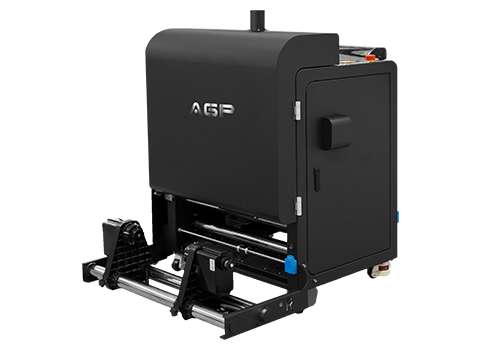
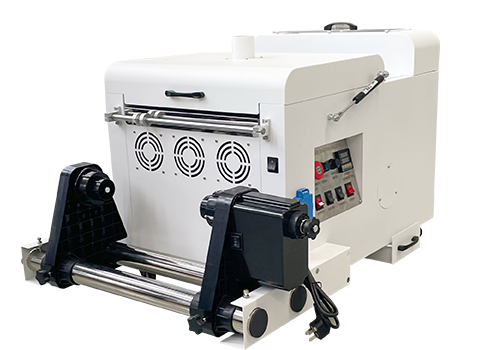
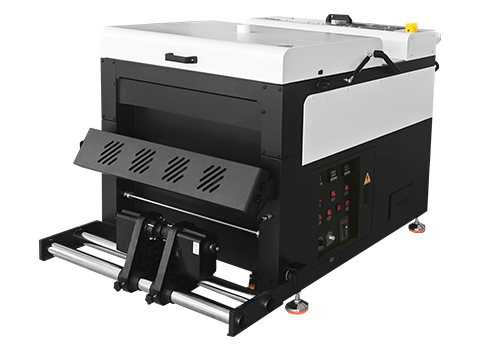
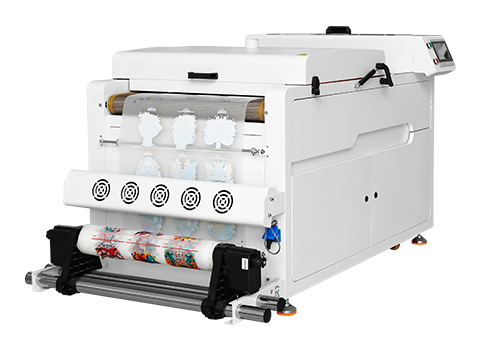
| 3 | Powder consumption per m², manual vs automated | Defines the automation crossover point |
| 4 | Expected head life in production hours, and head cost | Lets you amortise the most expensive wear item |
| 5 | Recommended spare kit contents and shipping time | Turns line 5 from unknown into a number |
| 6 | What installation and onboarding include | Labour line, month one |
| 7 | Warranty coverage per component, in writing | Defines line 4 boundaries |
| 8 | Two reference customers running similar volume | The only real-world data you will get |
Three Errors That Distort the Comparison
1. Comparing machines at different levels of completeness. One quote includes the shaker and RIP, another does not. Normalise to "ready to print the first transfer" before comparing.
2. Ignoring width in the film calculation. A narrower machine does not merely print smaller — it wastes more film on larger artwork. At the same order volume, two machines of different widths can differ by a third on film cost alone.
3. Treating the cheapest machine as the lowest-risk option. Risk is not purchase price. It is downtime multiplied by your ability to absorb it. A machine that stops for two weeks in your busy season costs more than any difference between quotes.
Frequently Asked Questions (FAQ)
What is the true cost of owning a DTF printer?
Five lines: acquisition, consumables, labour, spares and downtime. Acquisition is paid once and is the only line every supplier quotes; the other four recur and grow with volume. Any comparison that stops at purchase price is incomplete by roughly half.
How do I calculate DTF cost per shirt?
Print cost per transfer, then add garment cost and your labour for pressing and packing. Use cost per sellable transfer — not per square metre — because that is the unit you quote to customers.
What is the biggest hidden cost in DTF printing?
Labour, in most shops. At low volume, manual powdering, curing and pressing consume more value than ink and film combined. It is also the line that automation removes, which is why the shaker decision is usually more consequential than the printer decision.
Should I buy the shaker and oven with the machine?
Buy the shaker with the machine if you expect to exceed roughly 30 transfers a day within six months — retrofitting costs more than bundling, and manual powdering becomes your quality variance before it becomes your throughput ceiling. The oven can follow slightly later if you have a controlled press.
Why do quotes for the "same" DTF printer vary so much?
Because "same" usually means same printhead, not same frame, board, ink system or duty cycle. Ask for the bill of materials for the specific subsystems — head, board, ink pump, rail, frame — and the variance explains itself.
How do I compare two suppliers fairly?
Send both the eight-item list above and require written answers. Then normalise to "ready to print", add the recommended spare kit, and compare the total. A supplier who answers all eight is a supplier who has been through this before.
Get the Five Numbers for Your Configuration
Send us your design size, monthly volume and fabric mix, and we will return consumption figures, recommended spare kit contents and head life estimates for the configuration that fits — the same data you need for the formula above.